Chapter 1
From The Tuesday Playbook
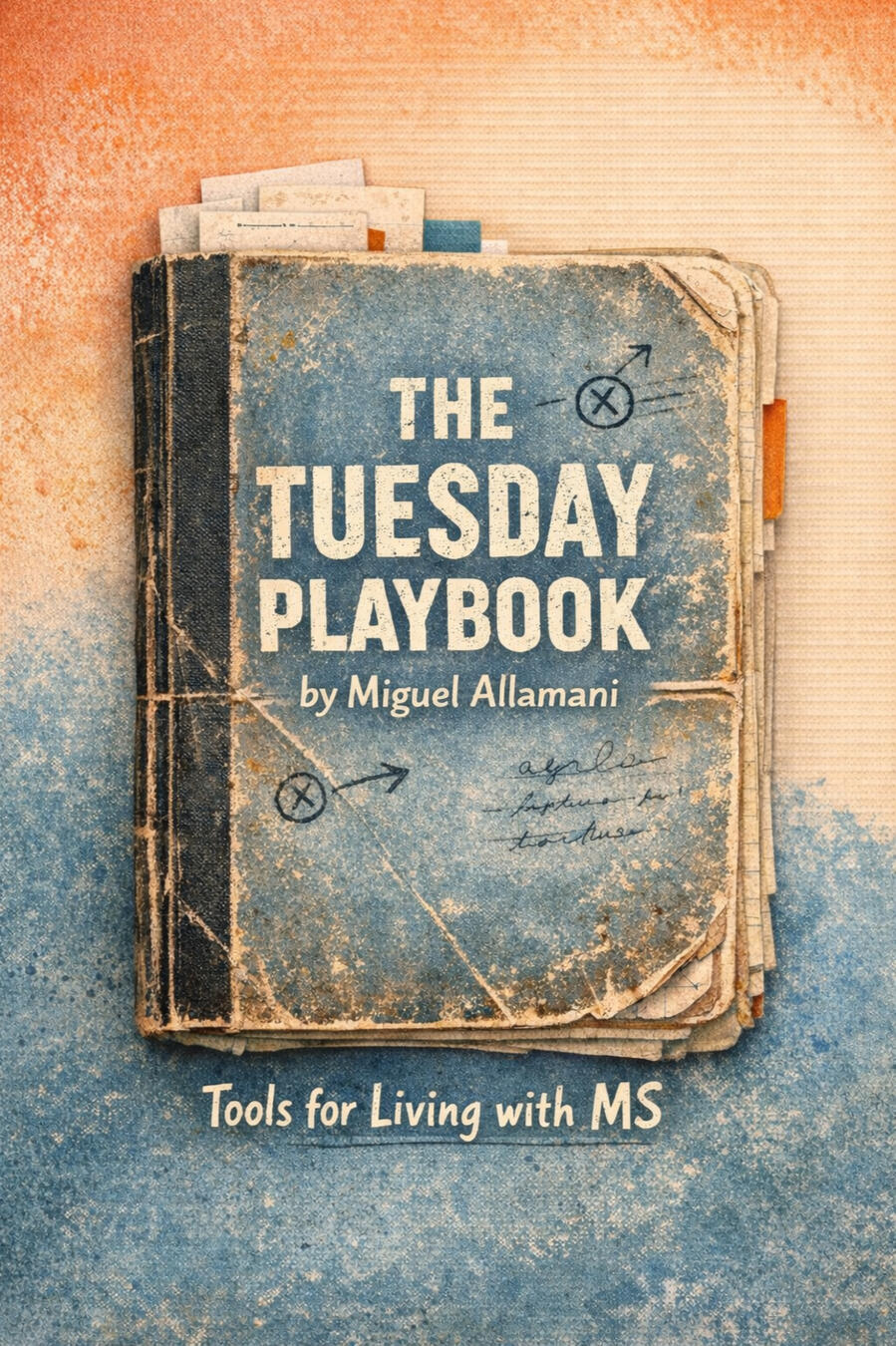
A short excerptChapter One from The Tuesday Playbook, Miguel Allamani’s honest, practical guide for living with MS, identity change, limitation, and adaptation.
CHAPTER 1 — THE TUESDAY MAP
The Tuesday Map is not really about planning.
Not in the normal productivity sense, anyway.
It’s not a hack for getting more done. It’s not a cute checklist. It’s not me pretending I can out-organize Multiple Sclerosis.
The Tuesday Map is how I protect what matters before the day takes a swing at it.
That’s what it really is.
Because if I don’t choose the day on purpose, the day chooses for me.
And when that happens with MS, the day usually chooses badly. It chooses chaos. It chooses overpromising. It chooses guilt. It chooses the wrong task at the wrong time. It chooses pain spilling into everything else I care about.
That’s why I map the day.
Not because I’m trying to be efficient. Because I’m trying to stay myself.
Before I build the day, I check three things: my body, the weather, and the obligations I can’t move.
How does my body feel? What colour am I waking up as?
What’s the barometric pressure doing? Did it swing overnight?
And what absolutely has to happen today, whether I like it or not?
That scan matters because it tells me what kind of day I’m walking into before I start pretending I can do everything.
My non-negotiables are usually simple and predictable. Getting my girls where they need to go. Therapy, if it’s a therapy day. Food. Meds. One real house task, if there’s room for it.
Those are the anchors.
That’s the stuff that actually matters.
And once I know the load, I start cutting.
The first things to go are extra errands, weird admin tasks, and anything optional that can wait another day. I’m not burning my nervous system today to chase a warranty issue that does not need solving today.
Optional social things get cut fast too. Not because I don’t care. Because sometimes the cost is too high.
Cleaning is different. Some cleaning stays.
Small cleaning tasks can actually help me feel more together, more human, more in control of my space. So it’s not “cut all cleaning.”
It’s “be honest about what helps and what drains.”
That’s the spirit of the map.
Honesty.
Before I had the Tuesday Map, mornings were mostly reaction.
Not thoughtful reaction. Not strategic reaction. Just me throwing myself at the day and hoping force would do the job.
That made mornings chaotic.
I’d wake up and immediately start chasing the day instead of sizing it up. I’d tell myself I could handle more than I could. I’d make loose promises to myself. I’d start stacking tasks without really counting the cost.
And when things began slipping, I didn’t get smaller.
I pushed harder.
Harder. Harder. Harder.
That was the mistake.
The day would get random. Half-finished things would pile up behind me. I’d have a mess in my wake — tasks half done, energy half spent, frustration fully active.
And then by late afternoon I’d be angry, disappointed, and wondering why I had slammed myself into the wall again.
That’s what life looked like before I started mapping.
The map changed that.
Not because it made MS easier. Because it made me more honest about what the day was going to cost.
And that honesty protects a lot more than energy.
It protects my dignity. It protects my patience. It protects my chance to stay engaged with my life instead of disappearing into the disease.
That’s the real point.
Because if I protect myself early, everything else has a better chance of staying in place. My role as a dad stays more intact. My marriage stays steadier. My mood doesn’t spill all over everybody else. I have a better shot at not taking my pain out on the people I love.
Protecting myself is how I protect everything else.
That matters to me.
Because the most dangerous thing in the morning is not just the weather, not even just the pain.
It’s the lie I tell myself.
And the lie is usually some version of:
I can do a little more today. I’m feeling strong. I can get ahead before the body catches up. If I push early, I’ll be fine.
That’s the hustle lie.
That’s the trap.
It sounds productive. It sounds optimistic. It sounds like I’m being tough.
Really, it’s just me trying to negotiate with reality before I’ve even checked what reality is.
A real example is today.
The barometric pressure is rough. A storm is coming. My body is already paying for snow work from last week, and my shoulders and arms are still sore from it.
I’ve got things that matter. I have to take one of my girls somewhere. I have to cook my dinners for the week.
Those are real.
But because it’s March break, I don’t have all the extra school-running chaos layered on top.
So what do I do?
I don’t panic. I don’t fantasize. I don’t start inventing ten other things to prove I’m still productive.
I protect myself.
That means I keep the plan tight. I do what matters. I stop the disease and the weather from dragging me into a day that turns me into a worse husband, a worse dad, a worse version of myself by evening.
That’s the map in action.
And one of the biggest threats to it is guilt.
Guilt tells me I should be able to do more. That I’m being lazy. That other people need more from me.
Those thoughts don’t come out of nowhere. I grew up around people who pushed through everything, and that hard-charger voice still lives in my head.
So part of the map is not just planning the day.
It’s refusing to let guilt redraw it into something my body can’t actually carry.
The traps are pretty predictable by now.
Doing too much too quickly. Skipping water. Ignoring the weather. Letting one decent hour trick me into overcommitting. Trying to run the whole day on mindset alone.
I’m not anti-hope. I’m not anti-optimism.
But hope is not a substitute for pacing.
A decent mood is not a plan.
If I treat positivity like fuel, I usually end up paying for it later.
The warning lights are usually simple too.
My brain starts buffering. My stride shortens. My back stiffens. The nervous system noise gets louder.
Sometimes MS is not one clean symptom. Sometimes it is too many signals at once.
Those are my dashboard lights.
They tell me the map is slipping.
And when the map starts slipping, I have to go smaller, not bigger.
A real example: on a therapy day, I woke up with pain running up and down my back and trouble moving. That immediately told me the day had limits.
Therapy sat right in the middle of the day, which meant it was the big ask.
So my map got very simple:
Get the kids to school.
Get breakfast and straighten the kitchen.
Get to therapy and get back home safely.
Feed myself again with my main meal.
Pick up the kids and get them back home.
That was it.
Nothing extra. No fantasy productivity.
Just the five.
That’s the part that matters: choose your five before the day chooses for you.
Because if I don’t decide what matters, the disease and chaos will decide for me.
And I do not want that making my decisions.
When I don’t map the day, I don’t just get tired.
I start disappearing into the disease.
I overextend. Stuff gets chaotic. I hurt more. I get angry. I feel ashamed. I feel guilty that I can’t do more. I start feeling useless.
And then the day isn’t just physically hard — it starts swallowing my sense of self too.
That’s the bigger cost.
A well-mapped day feels very different by evening.
Not perfect. Not miraculous.
Just cleaner.
Calmer. Less ashamed. More in control. Less wrecked. More engaged.
That word matters: engaged.
Because being engaged with my life is the point.
Not just surviving the day. Not just symptom control. Not just getting through.
I want to be present with my girls. I want to sit with Natalie and actually enjoy the night. I want to laugh. I want to feel some pride at the end of the day instead of only frustration. I want the day to still feel like mine.
A good mapped day gives me a chance at that.
A good example is a day where the weather is ugly, I’ve already had to cut something, and yet because I cut it without guilt, the rest of the day still works.
I can still get back to the book. I can still have a decent night. I can still be there instead of sitting inside my own misery.
That’s what the map can do.
It doesn’t always give me a productive day.
Sometimes it gives me something better:
a day that still feels like my life by the time I reach the evening.
Tuesday Triage
This is how I stop the day from choosing me.
What color am I right now — Green, Yellow, or Red?
What’s the one non-negotiable today?
What can I cancel or downgrade with zero guilt?
What do I need first: water, food, stretch, quiet?
What’s my next 30 minutes?
That’s it.
Not the whole week.Not the whole life.
Just the next honest block.
For me, most days I wake up somewhere between Green and Yellow. Sometimes I wake up Yellow with a Red edge. Sometimes I joke and call it Lime — not catastrophic, just touchy, easy to tip, a little sour.
I can slide into Red fast if the day gets chaotic.
And sometimes, if I’m careful, I can climb toward Green.
That’s why I use a simple shorthand.
Green / Yellow / Red
Green: I’m good. Normal day rules apply. Yellow: I can function, but keep it tight. One thing at a time. Red: Brain cooked. Tapped out. No new asks. Give me 20 minutes of quiet.
That language helps me communicate the day without giving a speech.
“I’m Yellow. Keep asks tight.”
“I’m Red. I need 20. Quiet. No questions.”
For my girls, it can be as simple as:
“Sorry, boo. I’ve got nothing left right now. I’m tapped.”
And when shame starts creeping in, I use one more tool.
Blame Filter
This isn’t a morality issue.
It’s a load issue.
That sentence matters because my brain loves to turn a hard day into a character judgment.
Lazy. Weak. Failing.
But most of the time, it’s not that.
It’s just load.
The weather. The body. The obligations. The extra that got added. The map getting redrawn by guilt.
A good map doesn’t guarantee a good day.
It just gives me a better shot at staying myself inside it.
About the AuthorMiguel Allamani is a Canadian writer and artist living with Multiple Sclerosis. His work focuses on identity, adaptation, grief, dignity, and the lived reality of chronic illness without pity, false hope, or “overcoming” language. He is also the creator of More Than MS, a graphic memoir about living with MS.For publishing, media, or speaking inquiries, please contact:
[email protected]